| Choosing the right study abroad destination is crucial. Explore key factors — rankings, cost, culture, career goals — and how Bac International guides your decision. |
Deciding where in the world to pursue your education is one of the most consequential choices you will ever make. The right combination of country, institution, and programme can set the trajectory of your entire career. The wrong choice — made without adequate research or guidance — can lead to academic frustration, financial strain, and missed opportunities. This guide is designed to help you approach this decision with clarity and confidence.
Start with Your Academic and Career Goals
Before examining individual universities or countries, it is essential to have a clear understanding of what you hope to achieve from your international education. Ask yourself the following foundational questions:
- What field of study are you pursuing, and which countries are recognised as global leaders in that discipline?
- Do you intend to work in your study destination country after graduation, or return to your home country?
- Are you seeking a one-year postgraduate programme, a full undergraduate degree, or a short-term exchange?
- What type of learning environment suits you best — large research universities or smaller liberal arts colleges?
Your answers to these questions will substantially narrow your options and provide a useful framework for evaluating potential destinations.
Top Study Destinations and Their Strengths
United Kingdom
The UK is home to some of the world’s most prestigious universities, including Oxford, Cambridge, Imperial College London, and the London School of Economics. The UK’s one-year master’s programmes are particularly attractive for students seeking a time-efficient path to a postgraduate qualification. The country’s multicultural society and its position as a global financial and cultural hub make it an outstanding choice for business, law, medicine, and the arts.
Canada
Canada has emerged as one of the most popular study destinations globally, and for good reason. Its universities consistently rank among the world’s best, tuition fees are generally lower than those in the United States or the UK, and Canada’s post-study work visa pathways are among the most generous in the world. The country’s inclusive, multicultural identity also ensures that international students are welcomed and supported.
Germany
For students who are either German-speaking or willing to invest in language learning, Germany offers an extraordinary proposition: tuition-free or very low-cost university education at institutions of exceptional quality. Germany is particularly renowned for its engineering, technology, and sciences programmes.
Australia
Australia combines world-class universities with an outstanding quality of life, a vibrant international student community, and excellent post-study work opportunities. Its universities are highly regarded in the fields of science, business, agriculture, and environmental studies.
Evaluating Universities: Beyond the Rankings
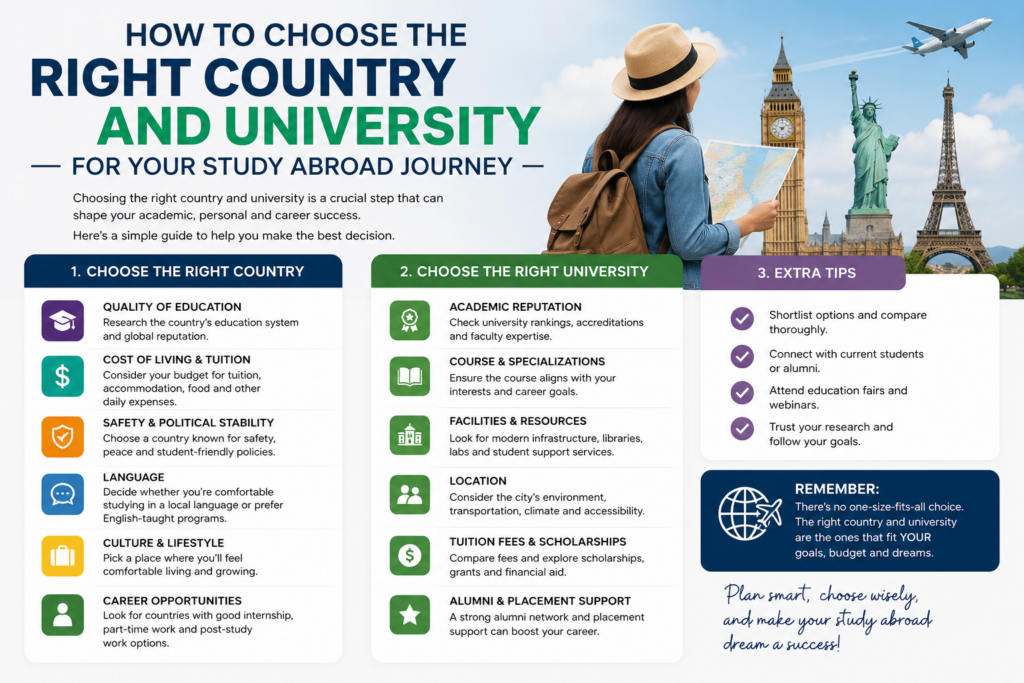
While global university rankings such as the QS World University Rankings and the Times Higher Education World University Rankings are useful starting points, they should not be the sole basis for your decision. Consider the following additional factors:
- Programme-specific rankings, which may differ significantly from overall institutional rankings
- Graduate employment rates and industry connections for your chosen field
- The quality and availability of student support services for international students
- Campus culture, student societies, and extracurricular opportunities
- Cost of tuition and living expenses relative to your financial capacity
The Role of Language and Cultural Fit
Language proficiency requirements are a practical consideration that must not be overlooked. Most English-medium universities require proof of English language proficiency through tests such as IELTS, TOEFL, or PTE Academic. If you are considering studying in a country where English is not the primary language of instruction, investing in language training well in advance of your application is strongly advisable.
Cultural fit is equally important. Adapting to a new cultural environment is an enriching but sometimes challenging process. Researching the local culture, social norms, climate, and lifestyle of your prospective destination will help you make a more informed and realistic choice.
Making the Decision with Expert Guidance
The sheer volume of information involved in selecting a study destination and university can be overwhelming. The consultants at Bac International bring years of experience and in-depth knowledge of international education systems to help you make this critical decision with confidence. From initial destination counselling to final university selection and application, we are with you every step of the way. Ready to take the next step? Bac International’s expert consultants are here to guide you every step of the way on your journey to finding the perfect study destination. Contact Us today at www.bac.com.bd and let us turn your global ambitions into reality.